Indonesia: a landmark money laundering conviction in a forestry crime case
Indonesia: a landmark money laundering conviction in a forestry crime case
Investigators from Indonesia’s Ministry of Environment and Forestry achieved their first-ever money laundering conviction linked to an environmental crime following an illegal logging case in Alas Purwo National Park. After a 2021 Constitutional Court decision expanded the authority of environmental investigators to pursue money laundering offences, the Ministry applied a follow-the-money approach alongside the Financial Intelligence Unit and the Attorney General’s Office. Businessman Supono was first convicted for illegal logging and later for laundering approximately USD 127,000 through layered bank transfers and a “loan-back” scheme. Although modest in value, the case set an important precedent by integrating financial crime investigations into environmental enforcement and demonstrated how legal reform, inter-agency cooperation, and targeted training can strengthen action against green corruption. 
章节大纲
-
November 2025
Indonesia: a landmark money laundering conviction in a forestry crime case
How investigators of Indonesia’s Ministry of Environment and Forestry achieved their first conviction for money laundering linked to forestry offences, leveraging institutional and legal changes in financial investigation procedures.
Author: Lakso Anindito, Team Leader Indonesia, Green Corruption programme, Basel Institute on Governance
Key points
- In a case of illegal logging in Alas Purwo National Park, investigators of Indonesia’s Ministry of Environment and Forestry obtained their first money laundering conviction.
- This achievement was made possible through a 2021 Constitutional Court decision extending the power to pursue money laundering offences to investigators in charge of predicate offences, in this case timber trafficking. This power was previously limited to investigators of traditional law enforcement agencies, including the police and the Corruption Eradication Commission.
- Training and technical assistance by the Green Corruption programme of the Basel Institute on Governance contributed to strengthening law enforcement capacities to effectively handle money laundering cases and track illicit financial flows tied to environmental crimes.
- Sustained coordination and collaboration among the Ministry, Indonesia’s Financial Intelligence Unit and the Attorney General’s Office were pivotal in applying the follow-the-money approach to the illegal logging case.
- Businessman Supono was convicted initially of illegally trading rosewood and later of laundering approximately USD 127,000 he had obtained through log trading. In both cases, he was sentenced to prison and ordered to pay a fine.
- Although the amount of money laundered in this case and the imposed fines were relatively modest, the case set a precedent for integrating financial crime investigations into environmental enforcement. This paves the way for future, larger-scale prosecutions by investigators of environmental agencies.
The case
- In 2021, investigators at the Ministry of Environment and Forestry started investigating indications of illegal logging in Alas Purwo National Park in Banyuwangi, East Java. National Park staff had caught a transporter carrying illegally logged rosewood (sonokeling).
- The investigation began with an effort to identify who was benefiting from the illegal activities. A businessman named Supono was later identified as the beneficiary. He was the person who orchestrated the transport of the rosewood logs.
- In 2022, the Banyuwangi District Court convicted Supono of intentionally transporting and owning forest products (logs of 31 rosewood trees sourced from Alas Purwo National Park) without permit.[ii] The Court sentenced Supono to two years in prison and a fine of IDR 500 million (approx. USD 29,900). This first case was pursued purely on the basis of forestry crime charges.
- The Ministry’s investigators continued to pursue the case using a follow-the-money approach to trace the proceeds of the crime. They applied this approach in close collaboration with the Financial Intelligent Unit (PPATK), which contributed key information, and in coordination with the Attorney General’s Office. The financial investigation revealed:
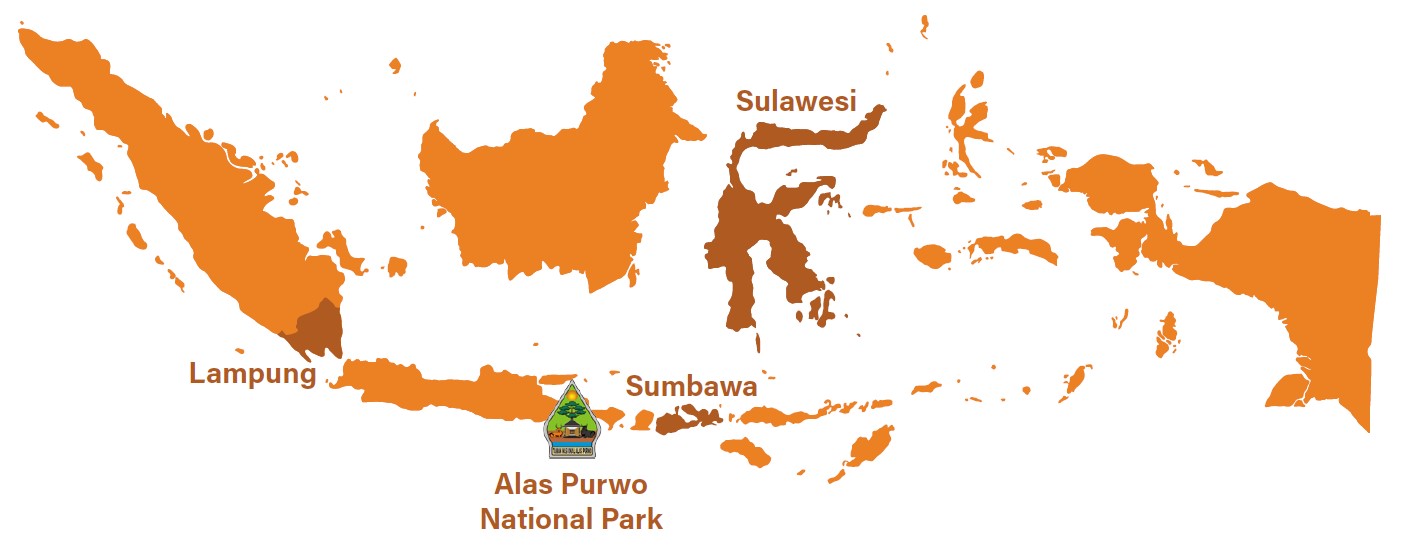
- Supono carried out suspicious financial transactions with two sawmill companies, PT Aji Sono and PT Amruu. His later statement during the court proceedings disclosed that the logs he was trading with these two companies were sourced not only from Alas Purwo National Park, but also from other locations, including Lampung, Sulawesi and Sumbawa.
- Between 2020 and 2022, Supono gained approximately USD 127,000 from trading logs with PT Aji Sono (IDR 1,454,440,000) and PT Amruu (IDR 670,980,800).
- To conceal the origins of the illegal proceeds, the two companies transferred the money for their log purchases to the bank account of Supono’s son, which was effectively controlled by Supono himself.
- Supono then moved the money from his son’s bank account to his own account in smaller transactions, both via direct transfer and via cash withdrawal and manual deposits.
- Supono integrated the proceeds of crime with money he had loaned from the bank in 2020 (when he had no specific need for a bank loan). He then used the illicit funds to pay back the loan. He used this “loan-back” method to disguise the proceeds of crime as legitimate money from the bank and other unrelated business activities.
- Among other things, Supono used the money from the logging business to buy land.
- In 2024, the Banyuwangi District Court issued its decision No. 11/Pid.Sus/2024/PN Byw[iii] declaring Supono guilty of money laundering. The Court sentenced Supono to one year and three months in prison and a fine of IDR 50 million (approx. USD 3,000). The proceeds of the crime as such were not recovered.
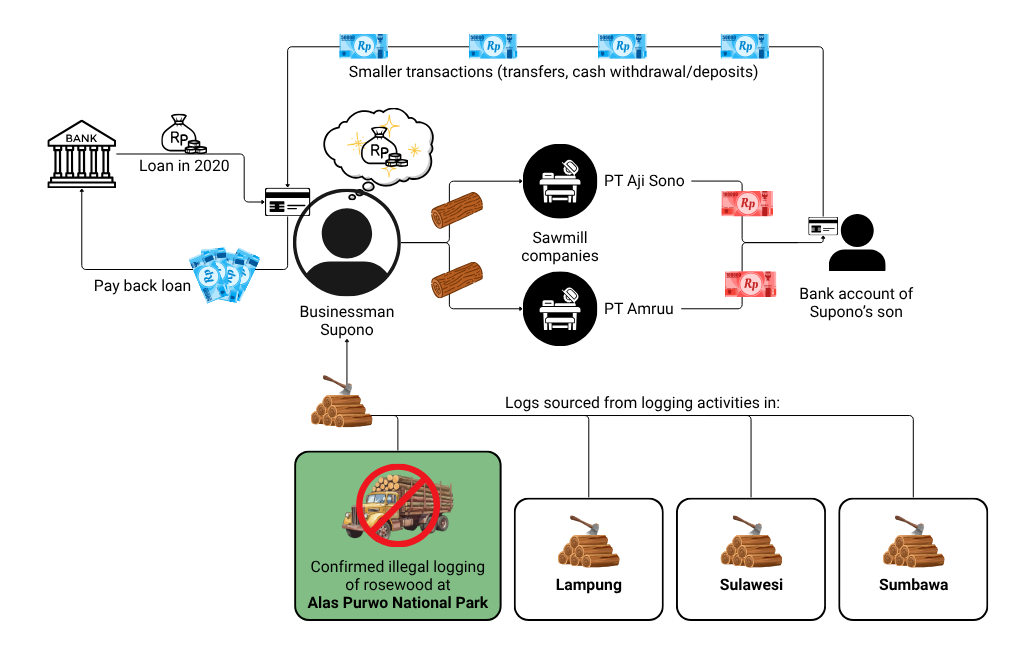
The illegal logging and money laundering scheme uncovered by investigators of Indonesia’s Ministry of Environment and Forestry.Legal background
- In 2010, Indonesia enacted the new Anti-Money Laundering Law No. 8/2010.[iv] It provides a legal framework for tracing and prosecuting illicit financial flows, including those linked to environmental crimes. This marked a major step towards integrating financial investigation tools into law enforcement efforts against money laundering. However, initially, only investigators of traditional law enforcement authorities were authorised to use this law, including from police, the Attorney General’s Office, the Corruption Eradication Commission, the National Narcotics Agency, the tax authority and customs.
- A landmark decision came in 2021 when the Constitutional Court issued its Decision No. 15/PUU-XIX/2021.[v] This authorised investigators in charge of predicate offences, including from natural resources and environmental authorities, to investigate not only environmental crimes such as timber trafficking but also the related money laundering offences.
- The Ministry of Environment and Forestry initiated several strategic actions to utilise its expanded powers. For example, it reached an agreement with the Indonesian Financial Intelligence Unit to develop a joint investigation team. The Ministry also set its investigators the target of handling environmental cases using a follow-the-money approach, and started collaborating with the Attorney General’s Office.
What can we learn from this case?
Laws and their interpretation are important…
The Constitutional Court’s 2021 Decision is an important example of how a legal framework can be interpreted to maximise its effectiveness in practice. In this case, the decision granted investigators from environmental agencies – in addition to investigators from traditional law enforcement agencies – the legal authority to pursue money laundering offences linked to environmental crimes.
It empowered investigators to expand their scope and approach, laying the groundwork for more comprehensive enforcement in the future.
… but using laws in practice requires training and “learning by doing”
Despite their new powers, the investigators still faced difficulties in tracing illicit financial flows and understanding complex financial transactions linked to environmental crimes. They lacked knowledge and practice in gathering financial intelligence, using investigative technology and cooperating with other agencies domestically or abroad.
Ongoing training in financial analysis and intelligence gathering can equip investigators with the necessary skills, tools and networks to tackle money laundering activities, including those linked to environmental crimes.
A “learning by doing” approach helps – i.e. applying new skills in realistic case investigations, together with counterparts from other agencies.
The value of hands-on, inter-agency training
As part of an Illegal Wildlife Trade (IWT) Challenge Fund project, the Green Corruption team of the Basel Institute on Governance has trained Indonesian law enforcement agencies to effectively handle money laundering cases and track illicit financial flows tied to illegal logging and wildlife-related crimes with the follow-the-money approach.
The training brought together investigators and prosecutors from key government agencies, including from the Ministry of Environment and Forestry, Ministry of Marine Affairs and Fisheries, Attorney General’s Office and Financial Intelligence Unit. Participants formed inter-agency groups and collaborated on a realistic case scenario, with each person contributing based on their respective role. The training used practical tools and exercises to explain how criminals conceal money and other assets through shell companies, business fronts, real estate investments and tax havens.
Besides training, the Basel Institute also supported the Ministry of Environment and Forestry in developing guidelines to handle money laundering cases, providing technical knowledge on the investigation process.
It was just a few months after the training that the Ministry’s investigators, in collaboration with the Attorney General’s Office and the Financial Intelligence Unit, achieved their first successful convictions for money laundering related to forest crimes.
Real cases – even when modest – can have a big impact
This case set a precedent for integrating financial crime investigations into environmental crime cases.
Even though the amount of money laundered in this particular case was relatively low – and the fines Supono was sentenced to pay were a small fraction of that amount – the case has opened the door to tackling more complex, high-value cases in the future.
This first case also played an important role in helping the Ministry of Environment and Forestry’s investigators to:
- shift their perspective from investigating illegal logging crimes only to handling money laundering offences; and
- move from a general understanding of money laundering in theory to handling real-life cases in
While training and guidelines were necessary to support the process, the real case itself served as a critical opportunity to identify both obstacles and solutions in applying the follow-the-money approach.
Both leaders and frontline investigators need to take action
Every natural resource trafficking case has a potential for exploring money laundering due to the amount of money involved in this type of crime.
A successful investigation requires initiative from investigators and support from decision-makers. In this case of illegal logging in Alas Purwo National Park:
- The Ministry of Environment and Forestry’s Director General and Director of Investigation encouraged investigators to adopt the follow-the-money approach.
- At the technical level, investigators put this encouragement into action, demonstrating their commitment to following the money in existing predicate crime cases.
Inter-agency collaboration is vital
Coordination between the relevant agencies from the outset of the investigation has been pivotal to concluding the case successfully. The mutual understanding between counterparts from the Ministry of Environment and Forestry, Attorney General’s Office and Financial Intelligence Unit provided a strong foundation for the enforcement process.
Keywords
- Indonesia
- Environmental crimes
- Illegal logging
- Money laundering
- Financial investigation
About this Case Study
This publication is part of the Basel Institute on Governance Case Study series, ISSN 2813-3900. It is licensed for sharing under a Creative Commons Attribution-Non-Commercial-NoDerivatives 4.0 International Licence (CC BY-NC-ND 4.0).
Suggested citation: Anindito, Lakso. 2025. “Indonesia: a landmark money laundering conviction in a forestry crime case.” Case Study 12, Basel Institute on Governance. Available at: https://baselgovernance.org/publications/cs-12.
Acknowledgment and disclaimer
The development of this publication was funded through the Illegal Wildlife Trade (IWT) Challenge Fund.
The contents are the sole responsibility of the author and do not necessarily reflect the official position of the Basel Institute on Governance, its donors and partners, or the University of Basel.
[i] In 2024, the Ministry of Environment and Forestry was reorganised into the Ministry of Forestry on the one hand, and the Ministry of Environment/Environmental Control Agency on the other.
[ii] Summary of Decision No. 407/Pid.B/LH/2022/PN Byw, Banyuwangi District Court, https://putusan3.mahkamahagung.go.id/direktori/putusan/zaed4397785454c4b286313034383535.html.
[iii] Decision No. 11/Pid.Sus/2024/PN Byw, Banyuwangi District Court, https://putusan3.mahkamahagung.go.id/direktori/putusan/zaef59f06fe1f0be843f313035313037.html.
[iv] [Unofficial translation] Law No. 8/2010 on the prevention and eradication of money laundering crimes, Republic of Indonesia, https://ppid.ppatk.go.id/wp-content/uploads/2020/08/UU-No-8-tahun-2010.pdf.
[v] Decision No. 15/PUU-XIX/2021, Constitutional Court of the Republic of Indonesia, https://www.mkri.id/public/content/persidangan/putusan/putusan_mkri_7942.pdf.