Deconstructing a criminal network involved in illegal wildlife trade between East Africa and Southeast Asia
Deconstructing a criminal network involved in illegal wildlife trade between East Africa and Southeast Asia
This research deconstructs a transnational criminal network involved in illegal wildlife trade between East Africa and Southeast Asia, revealing how social network analysis and network ethnography can expose the structure and functions of such operations. The study identifies key roles—such as logistics, finance, concealment, and social ties—that sustain the trade of wildlife goods like ivory and rhino horn. It highlights how informal governance systems and repeated opportunistic behaviours evolve into organised, resilient criminal mechanisms. The findings offer valuable insights for law enforcement strategies that go beyond targeting individuals to disrupting broader network structures.
Схема розділу
-
September 2023
Deconstructing a criminal network involved in illegal wildlife trade between East Africa and Southeast Asia
We used social network analysis and network ethnography techniques to study the criminal network of a wildlife trafficker based in East Africa. The findings suggest that criminal networks are key to transforming opportunistic behaviours into ordered strategies and that organised crime makes the process more efficient and effective.
What’s the problem?
Illegal wildlife trade threatens biodi- versity and security worldwide. Criminal networks pocket billions of dollars in illicit profits from stripping the world bare of endangered species and corrupting politicians and public officials in the process.
There is very little empirical evidence on the role of both ordinary citizens and criminal networks in the illegal wildlife trade. How far does the network extend and what type of people does it include? How do these relational structures facil- itate the achievement of criminal goals and allow the network to sustain itself over time?
Our empirical analysis helped us to answer these questions by deconstructing a criminal network into its essential elements and structural characteristics, functions and meanings.
What we did
Where?
Key trade links between East Africa and Southeast Asia. The network also had links in West Africa, Europe and North America.
Who?
A wildlife trafficker in prison in the United States and his illicit links to Southeast Asian traffickers based between East Africa and Southeast Asia.
Why
- to empirically verify the role of criminal networks in facilitating the illegal trade of wildlife goods, such as rhino horns and ivory tusks in this case.
- to provide insights for law enforcement efforts aimed at identifying and dismantling wildlife trafficking networks.
How
By applying social network analysis and network ethnography techniques to a set of intelligence data, we were able to understand the complex criminal network surrounding a wildlife trafficker based in East Africa who traded a large volume of wildlife goods with Southeast Asian countries.
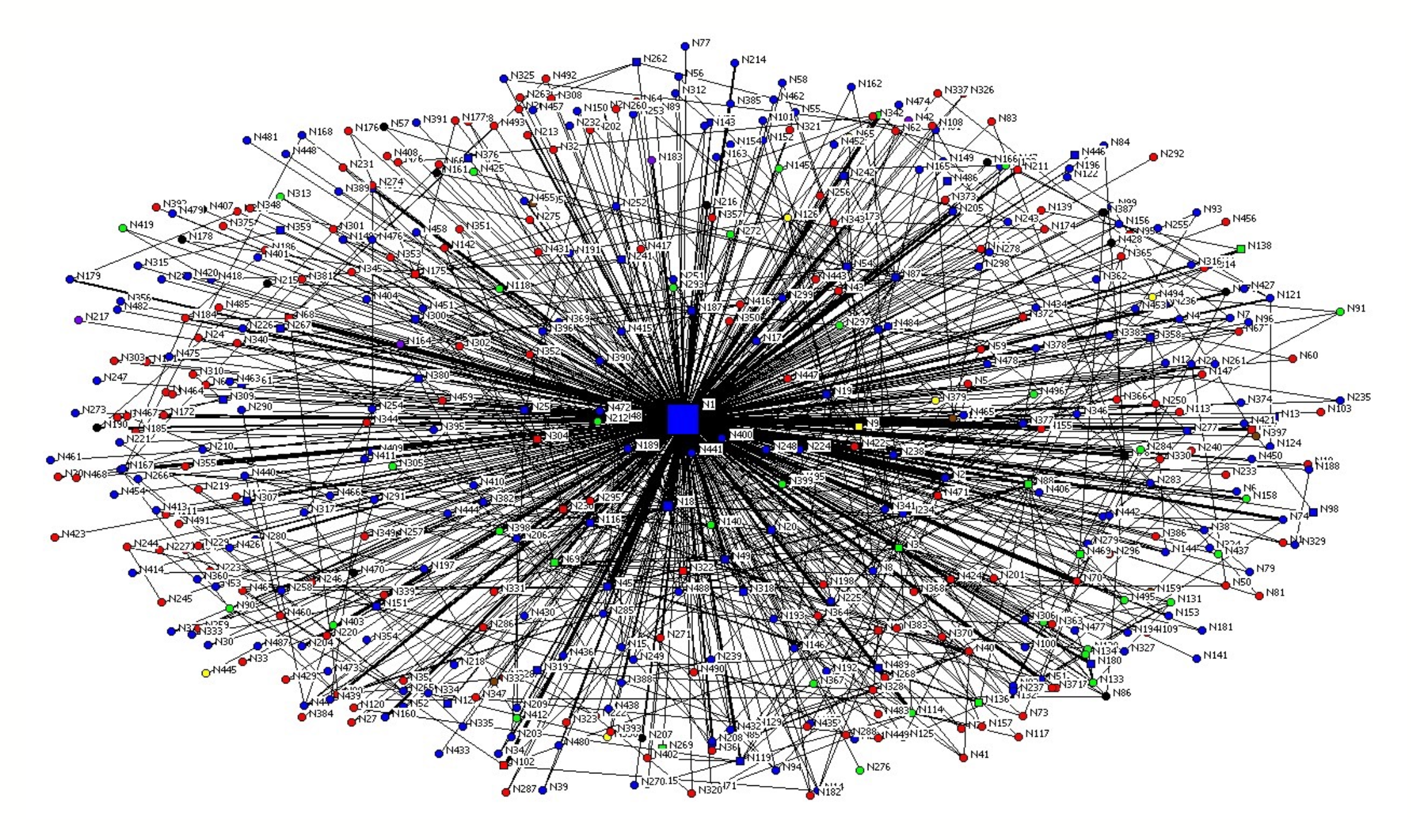
A graphic visualisation of the large and complex criminal network surrounding the wild- life trafficker, comprising 495 individuals and spanning different countries and regions. What we found
The five functions critical for the criminal network to achieve its trafficking goals are:
- Networking to create a pool of collaborators with particular skillsets and social capital that can be activated as needed, and to coordinate the activ- ities of co-offenders and suppliers.
- Financial flows to pay for the procurement of goods and their stockpiling in warehouses, their shipment and concealment, and the collaboration of professionals and co-offenders.
- Business and goods, i.e. the procurement of wildlife goods on illicit markets and the matching of supply and demand at the regional and global level.
- Delivery and shipment, i.e. the transport infra- structure and the logistics professionals (freight forwarders and clearing agents) who supply their expertise.
- Concealment of illegal activities from law enforcement.
Each of these functions relies on specific actors within the network. Some actors are concentrated in particular regions, while others have a wider geographical spread. Some specialise in one function, while others take care of more than one task.
The transnational crime chain is punctuated by multiple local spaces, individuals with different agendas and opaque clusters that manage the trade.
A criminal network may look like a shapeless amalgam of opportunistic behaviours, but their repetition, accumulation and stratification transform the network into an ordered and organised mechanism.
Criminal networks operate under an informal governance system based on bargaining and coordination between individuals in the network and with other groups.
This informal governance system has local, regional and transnational elements. Social structures such as family, friendship and kinship – and the social capital that they maintain as they move from one region to another – facil- itate operation all over the world.
Both opportunistic and organised behaviours shape the illegal wildlife trade and are critical in supporting and orchestrating this criminal phenomenon.
The criminal network operates as a machine of order that helps to reduce the chaos and complexity of the illegal activities.
Why it matters
Law enforcement and other practitioners can use this research to develop more effective strategies which consider the local, regional and transnational elements of illegal wildlife trade, the mix of opportunistic and organised behaviours, and the informal governance system that bonds offenders.
The findings are also important for evaluating the effec- tiveness of current approaches to countering illegal wildlife trade or other organised nature-based crime. For example, arresting key traffickers may not disrupt the entire criminal network, which can survive thanks to the resilience of the smaller clusters that coalesce around hubs in the network.
The techniques we applied are powerful complementary tools for understanding criminal enterprises. Cooperation between law enforcement agencies and researchers skilled in social network analysis and network ethnog- raphy will bring benefits to the fight against illegal wildlife trade and other forms of trafficking.
Where to learn more
Working Paper 35
Social network analysis applied to illegal wildlife trade between East Africa and Southeast AsiaJournal article
Structures, functions and flows of IWT: deconstructing a criminal network between East Africa and Southeast AsiaPolicy Brief 6
Bringing intelligence and social network analysis together to fight illegal wildlife tradeAbout this Research Case Study
This publication is part of the Basel Institute on Governance Research Case Study series. It is licensed for sharing under a Creative Commons Attribution-NonCommercial-NoDerivatives 4.0 International License (CC BY-NC-ND 4.0).
This report was funded by PMI IMPACT, a grant award initiative of Philip Morris International (PMI). In the performance of their research, the authors maintained full independence from PMI. The views and opinions expressed in this document are those of the authors and do not necessarily reflect the views of PMI. Neither PMI, nor any of its affiliates, nor any person acting on their behalf may be held responsible for any use which may be made of the information contained herein.
Suggested citation: Costa, J. 2023. ‘Deconstructing a criminal network involved in illegal wildlife trade between East Africa and Southeast Asia.’ Research Case Study 4, Basel Institute on Governance. Available at: baselgovernance.org/publications/research-case-4.
Keywords
social network analysis, illegal wildlife trade, network ethnography, East Africa,informal governance, Southeast Asia