Windward Trading: Charging a shelf company with money laundering and returning confiscated funds to Kenyan citizens
Windward Trading: Charging a shelf company with money laundering and returning confiscated funds to Kenyan citizens
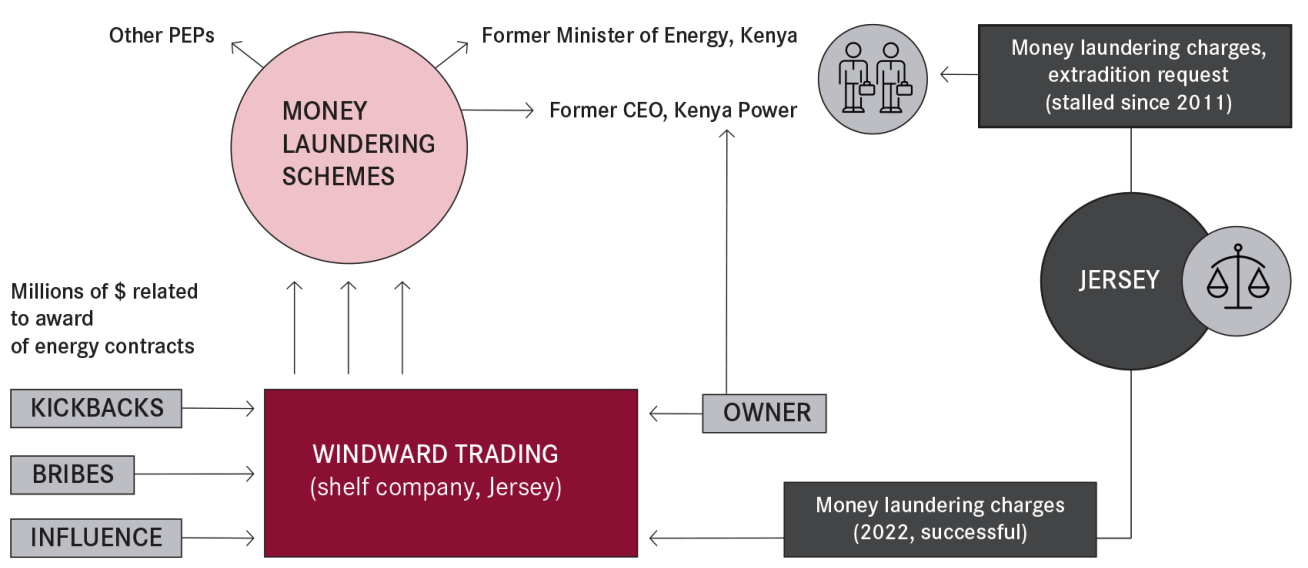
In the Windward Trading case, Kenya and Jersey collaborated to recover and repatriate approximately USD 3.7 million in corruptly acquired funds held since 2011. The money was traced to Windward Trading Ltd, a shelf company used by Kenyan officials—including former Kenya Power CEO Samuel Gichuru and ex-Energy Minister Chrysanthus Okemo—to channel bribes through accounts at HSBC. Efforts to extradite the individuals involved stalled for years, delaying formal asset recovery. To overcome this, authorities charged Windward Trading directly with money laundering, resulting in a guilty plea and a court-ordered confiscation of the funds. A breakthrough came through informal cooperation and the mutual decision to return the assets to Kenya for health-related development, including medical equipment and pandemic relief.
This case marked Jersey’s first repatriation of confiscated assets to Kenya and inspired the creation of the Framework for the Return of Assets from Corruption and Crime in Kenya (FRACCK), which promotes transparency and development-focused use of recovered assets. The success of the initiative underscores the effectiveness of informal collaboration, non-conviction-based forfeiture mechanisms, and innovative legal approaches like charging corporate entities. It also emphasizes the importance of trust and accountability in international asset recovery, with Crown Agents and Amref Health Africa appointed to ensure transparent disbursement of funds for public benefit.
Схема розділу
-
September 2022
Windward Trading: Charging a shelf company with money laundering and returning confiscated funds to Kenyan citizens
How Kenya and Jersey broke a years-long deadlock to channel USD 3.7 million in confiscated funds to Kenya for medical equipment and pandemic relief.
Simon Marsh, Senior Investigation Specialist and Coordinator Southern and East Africa, Basel Institute on Governance
Key points
- → Kenya and Jersey worked together to unlock progress in a long-running case involving around USD 3.7 million in corruptly acquired funds.
- → The money was held in the bank account of the shelf company Windward Trading, which was used to channel corrupt payments relating to power generation in Kenya.
- → The money had been seized in Jersey since 2011 following a money laundering investigation and subsequent criminal proceedings. The Kenyan Ethics and Anti-Corruption Commission (EACC) worked with the Jersey authorities to establish reasonable grounds to suspect the funds were proceeds of corruption. But the case had stalled due to issues with extraditing the two suspects to Jersey to stand trial.
- → Proactive informal cooperation was key to building trust between the parties. This helped to break the deadlock, find legal solutions to recover the funds and agree their safe return for the benefit of Kenyan citizens.
- → The parties mutually agreed that the recovered assets should be used for medical equipment and pandemic relief in Kenya. Crown agents and Amref Health Africa are responsible for disbursing and safeguarding the funds.
- → A framework agreement signed by the Governments of Kenya, Jersey, Switzerland and the UK was used as a basis for negotiations on the return of the funds.
The case
- The Government of Kenya liberalised power generation in 1986, but the state-owned Kenya Power and Lighting Company (KPLC or Kenya Power) retained a monopoly in the market. This gave Kenya Power's then CEO Samuel Gichuru wide gate-keeping powers over the negotiation of power purchasing contracts.
- In the same year, Mr Gichuru acquired Windward Trading Ltd, a shelf company registered in Jersey. A shelf (or 'off the shelf') company is similar to a shell company but older: it is a company that has no business activity but has been created, left dormant and put on the 'shelf' for a period of time. It is then sold to someone who would prefer to have an existing corporation than a new one. Both shell and shelf companies are vulnerable to misuse for money laundering. 1
- Millions of pounds sterling, US dollars and other currencies were channelled through the shelf company's account at HSBC bank between 1986 and 2002.
- Financial evidence indicates that the ultimate beneficiaries of these payments included senior public officials and other politically influential persons, notably former Minister for Energy Chrysanthus Okemo.
- Based on the evidence, Kenya's Ethics and Anti-Corruption Commission (EACC) suspected that the payments were bribes relating to the award of public contracts by Kenya Power.
- The Jersey Law Officers' Department initiated domestic investigations and instituted criminal proceedings against Mr Gichuru and Mr Okemo for money laundering in 2011. These proceedings resulted in a request for extradition of both defendants to Jersey to stand trial. The extradition request has been pending in Kenya since that time, including due to the two suspects making numerous appeals and a constitutional legal resolution regarding extradition.
- Following informal meetings between ICAR and representatives of the two concerned countries, an attempt was made in 2015 to break the stalemate generated by the stalled extradition request in order to be able to finally confiscate some of the illicit funds. The Kenyan Attorney General wrote to the Jersey authorities formally requesting the repatriation of the funds held by Windward Trading.
- The Jersey Law Officers' Department then charged Windward Trading, as a corporate entity, with money laundering. Windward Trading pled guilty to four counts of money laundering in February 2016 on the basis of no liability for the nominee directors.
- The Royal Court in Jersey subsequently granted a confiscation order for approximately GBP 3.6 million (around USD 4.4 million). 2 Windward Trading did not contest the confiscation.
- The Jersey authorities indicated that they would seek to repatriate the funds to Kenya for development purposes, minus a contribution towards the costs amounting to several hundred thousand dollars. The extradition proceedings of the two named officials continue.
- This was the first time that Jersey was repatriating confiscated assets to Kenya. Both jurisdictions desired to ensure transparent end use of the confiscated assets, oriented to the sustainable development goals (SDGs). This triggered the development of the Framework for the Return of Assets from Corruption and Crime in Kenya (FRACCK). Signed in 2018 by the Governments of Kenya, Jersey, Switzerland and the UK, FRACCK sets out good practices for the return of stolen assets to Kenya. It encourages transparency and accountability, as well as the use of returned assets to advance sustainable development and benefit citizens.
- Jersey and Kenya signed an Asset Return Agreement in March 2022 building on the FRACCK agreement's framework and principles. The agreement foresees that 90 percent of the recovered assets from Windward Trading will be used for essential medical equipment (intensive care units and hospital beds). The remaining 10 percent will go to a community-based pandemic relief project (healthcare worker capacity and enhanced home-based care) in Kenya. Crown Agents and Amref Health Africa are responsible for disbursing the funds in these two areas respectively.
What can we learn from this case?
Charging a corporate entity with money laundering
The concept of charging a shelf company or other corporate structure with money laundering offences is a novel one. Given the well-documented use of such corporate structures to hide and transfer proceeds of corruption, this mechanism could be potentially be very useful in jurisdictions where legislation allows this.
The focus on legal persons (rather than 'only' on natural persons) is a trend we have observed in a growing number of countries in recent years. It is triggered by foreign bribery laws adopted in response to the OECD Anti-Bribery Convention.
Other jurisdictions may find themselves in a situation where they are restraining funds for a lengthy period of time due to legal proceedings in other jurisdictions over which they have no control. In this case, they could see if the Jersey example offers inspiration for finding an appropriate legal solutions to forfeit the funds.
This is important: if funds are sitting frozen in a bank account, they serve no purpose and the negative impact of the original crime persists.
Corruption is not a victimless crime. It has both direct and indirect consequences for people living in countries where corrupt practices have taken place. The signing of this agreement today shows that Jersey does not tolerate financial crime and that our officers will confiscate monies associated with corruption and ensure that such funds are returned for the benefit of the people who have suffered from the effects of corruption.
We have already prosecuted the Jersey company involved for money laundering offences, and continue to support the ongoing extradition proceedings by the prosecuting authority in Kenya to bring the individuals responsible to justice.
Proactive and informal collaboration
The major challenge in this case was that convoluted extradition proceedings left an important transnational case on ice and stood in the way of a confiscation.
The ongoing difficulties with the extradition request negatively impacted the parties' cooperation via formal exchanges of mutual legal assistance (MLA) requests. The result was that progress on confiscating the money frozen in Windward Trading's bank account had stalled.
The deadlock was broken through informal cooperation, which allowed the parties to build trust and understand each other's positions before exchanging formal MLAs. The power of informal cooperation to lead to progress in complex asset recovery cases is frequently underestimated and underused. 5 Success in asset recovery relies not only on applying laws and procedures, but on building relationships and trust.
In the end, the solution found is innovative, bold within the limits of the law, and only possible because of cross-jurisdictional collaborative thinking.
The unrelenting efforts over the last few years resolutely affirms the message that all proceeds of corruption once acquired, will ultimately be reapplied to the benefit of Kenyans, notwithstanding the period of time. The signing of the Agreement... illustrates how foreign parties can come together to agree upon good practices and approaches for the return of stolen assets and their use to advance sustainable development and benefit citizens.
Seeking solutions to return illicit assets beyond criminal convictions
Efforts to obtain a criminal conviction of an individual on corruption or money laundering charges frequently stall or fail, even where there is clear evidence that assets under their control are of a criminal nature.
The failure to obtain a criminal conviction might be due to the high standard of proof required, endless appeals by the affected parties, or as in this case issues with extraditing suspects to stand trial.
Whatever the reason for the delay in obtaining a criminal conviction, it is not a necessary consequence that asset recovery proceedings cannot be initiated. Non-conviction based forfeiture mechanisms, illicit enrichment laws, plea bargains, alternative dispute resolution mechanisms or other solutions - such as the concept used here of charging the corporate entity linked to the bank account - should all be explored.
Following the first use of Kenya's unexplained wealth law in a case against the former head of Kenya's Port's Authority, the EACC has seen a 100 percent success rate in the five subsequent cases, with an estimated USD 6.4 million in funds recovered in total. Many more cases are under investigation currently or going through the courts. Despite the initial challenges of applying new forms of legislation, our unexplained wealth law is proving a powerful tool in Kenya's fight against corruption. Alongside our strong civil forfeiture mechanism, it can also play a key role in the recovery of criminal proceeds.
Safeguarding returned assets
At every forum and every meeting on asset recovery, one of the pressing areas for discussion is the return and utilisation of assets that have been recovered either through criminal or civil proceedings. Some are sceptical when recovered assets are assimilated into the general state budget. They do not trust the controls that should protect these funds from being misused when they have apparently failed to prevent the original misuse.
It is our view that both the jurisdiction that is returning assets and the one that is receiving them (back) have a shared interest in ensuring that the recovered funds are not misused. Indeed, their shared interest extends to ensuring they are used in ways that will tangibly benefit citizens.
This concept lies at the heart of the FRACCK, whose development was initiated in part as a result of the progress in the Windward Trading case. The FRACCK consequently formed the basis for the negotiations over how to use the recovered assets from Windward Trading.
After evaluating options, the parties eventually agreed to use the funds for health equipment and pandemic relief. Both purposes will directly benefit the most vulnerable in Kenya. Also in line with the FRACCK, the parties further agreed to use Crown Agents and Amref Health Africa to disburse the funds. In this way, they ensured transparency and accountability in the end use of the recovered assets.
Government of Kenya is committed to working with partners such as United Kingdom, Switzerland and Jersey, to realise the aspiration of FRACCK. Other countries could learn best practices in tracking and repatriation of illicit funds from the implementation of this FRACCK initiative.
The FRACCK instrument, and subsequent Asset Return Agreement, serve as an excellent example of the imaginative approaches that the international community can explore to achieve meaningful progress in the recovery of stolen assets. I hope that this acts as a model of future returns under the FRACCK and will act as further demonstration of Jersey's continued commitment to the international cooperation in the fight against corruption.'
Keywords
Shell companies
Asset repatriation
Informal cooperation
FRACCK
Kenya
Jersey
About this Case Study
This publication is part of the Basel Institute on Governance Case Study series. It is licensed for sharing under a Creative Commons Attribution-NonCommercial-NoDerivatives 4.0 International License (CC BY-NC-ND 4.0).
Suggested citation: Marsh, Simon. 2022. 'Windward Trading: Charging a shelf company with money laundering and returning confiscated funds to Kenyan citizens.' Case Study 7, Basel Institute on Governance. Available at: baselgovernance.org/case-studies.
The Basel Institute's asset recovery work is funded primarily by the core donor group of the International Centre for Asset Recovery (ICAR): the Government of Jersey, Principality of Liechtenstein, Norwegian Agency for Development Cooperation (Norad), Swiss Agency for Development and Cooperation (SDC) and UK Foreign, Commonwealth & Development Office (FCDO).
The views expressed are those of the author and do not necessarily represent the views of these institutions and governments, or of the University of Basel.