Quick Guide 45
Quick Guide 45
Consider a criminal network that traffics drugs across several countries and conceals the proceeds through legitimate businesses, digital assets and real estate investments. Given the transnational nature of the criminal operation, multiple jurisdictions may be involved in investigations.
Here is where joint investigation teams (JITs) come into play. A JIT is a powerful international cooperation mechanism that can help turn fragmented cross-border efforts into a more coordinated and effective response to crime.
This Quick Guide explains what JITs are, why they are useful – including their potential to support cross-border asset recovery – and what the key considerations are for establishing and operating them.
Garis besar topik
-
Joint investigation teams
A Quick Guide by Rita Simões, Senior Specialist, Asset Recovery, Basel Institute on Governance
Consider a criminal network that traffics drugs across several countries and conceals the proceeds through legitimate businesses, digital assets and real estate investments. Given the transnational nature of the criminal operation, multiple jurisdictions may be involved in investigations.
Here is where joint investigation teams (JITs) come into play. A JIT is a powerful international cooperation mechanism that can help turn fragmented cross-border efforts into a more coordinated and effective response to crime.
This Quick Guide explains what JITs are, why they are useful – including their potential to support cross-border asset recovery – and what the key considerations are for establishing and operating them.
What is a joint investigation team?
A JIT is a formal mechanism of international judicial cooperation that allows authorities to coordinate action in investigations involving serious cross-border offences, such as drug trafficking, money laundering and fraud.
It facilitates the direct exchange of information and, where legally permitted, evidence between involved jurisdictions, reducing reliance on formal mutual legal assistance (MLA).[1] A JIT can also support coordinated operational measures such as searches and arrests.
It is established by formal written agreement between the competent authorities of two or more jurisdictions, for a specific purpose and a limited duration. It does not, however, create a supranational investigative authority. Investigative measures remain subject to the law and supervision of the jurisdiction in which they are carried out.
The following table summarises the benefits of JITs and what might impact their effectiveness in practice:
Advantages ⚠ Practical considerations Faster cooperation and direct communication between investigators and prosecutors across jurisdictions Building trust and agreeing working methods may take time. More effective, direct exchange and use of intelligence and evidence Rules governing the sharing, use and admissibility of intelligence and evidence may differ between jurisdictions. Coordinated cross-border investigative strategies and operational measures Different legal systems, procedures and operational capacities may affect cooperation. Better-aligned decisions on prosecution strategy and reduced risk of parallel proceedings Jurisdictional issues may require early discussion and agreement. What is the legal basis for a JIT?
A number of conventions support the establishment of JITs, including for instance Article 19 of the United Nations Convention against Transnational Organized Crime (UNTOC) and the Framework Agreement for Cooperation among the States Parties to MERCOSUR on Joint Investigation Teams. See the Annex for others.
Such conventions can provide an important foundation, but they do not necessarily address all legal and procedural issues that may arise in practice. First and foremost, a JIT agreement must be consistent with the legal frameworks of participating jurisdictions.
Member jurisdictions also need to consider, among other things, their domestic rules governing the collection, transfer and use of intelligence and evidence, admissibility requirements for evidence obtained abroad or chain-of-custody arrangements.
Who is involved in a JIT?
JIT members are representatives of competent national authorities that participate directly in the joint investigation, such as law enforcement officers, prosecutors and investigating judges. Participating jurisdictions normally designate a JIT leader each, usually the authority responsible for directing investigations at national level.
JIT members may conduct investigations within their own jurisdiction and, where permitted, participate as seconded members in investigative activities carried out in other participating jurisdictions. The powers of JIT members vary according to the terms of the JIT agreement and the domestic law of the jurisdiction in which they operate.
Additional participants who are not representatives of the competent authorities may be included to provide specialist, technical, analytical or coordination support.
Organisations supporting JITs
There are regional and international organisations that support the establishment and operation of JITs by providing legal expertise, coordination assistance, guidance or funding.
Examples include the European Union Agency for Criminal Justice Cooperation (Eurojust), the Network of National Experts on Joint Investigation Teams (the JITs Network) and the Criminal Cooperation Network (REDCOOP) of the Ibero-American Association of Public Prosecutors (AIAMP).
JITs and asset recovery
In practice, many JITs have been established to also support cross-border financial investigations and asset recovery.
In this context, and subject to the applicable domestic legal frameworks, cooperation within a JIT can facilitate:
- rapid exchange of financial intelligence and evidence;
- coordinated asset tracing across jurisdictions;
- aligned freezing strategies;
- timely decisions and coordination in confiscation proceedings; and
- the return of assets to victims.
Participating jurisdictions should consider involving specialised financial investigators, with expertise in digital assets where relevant.
Establishing and operating a JIT: key considerations
In order for a JIT to effectively support the fight against cross-border crime, various aspects must be considered at crucial decision points before, during and after its establishment and operation.
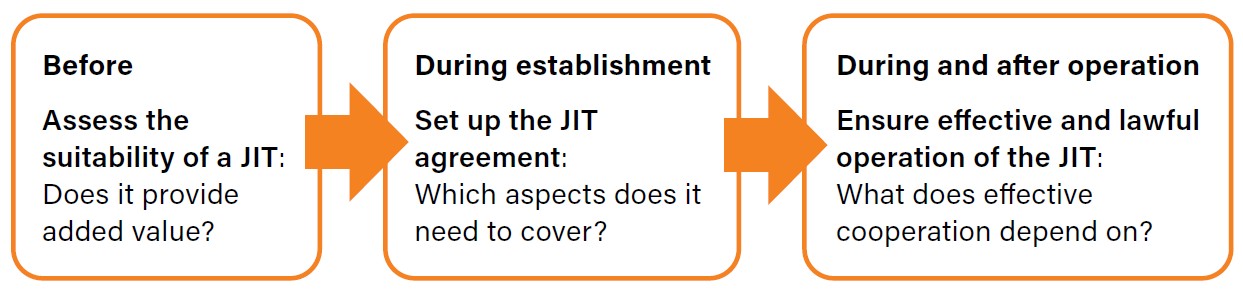
Assess suitability
Authorities should first consider whether a JIT provides added value compared to more traditional cooperation channels, such as mutual legal assistance.
- Are there connected investigations or cross-border criminal activities involving different jurisdictions?
- Are evidence, assets, suspects, victims or witnesses located across jurisdictions?
- Would coordinated action or cooperation through a JIT improve the effectiveness of the investigation?
- Is there a legal basis for establishing a JIT?
- Are involved authorities lawfully permitted to share and use information and evidence, and do they understand differences in evidential rules, procedural safeguards and investigative powers?
- Which jurisdictions are unlikely to join the JIT but may hold relevant evidence or assets, and how will cooperation with them be managed?
Agree the arrangements
Authorities then prepare the agreement that formally establishes the JIT. Model agreements are available in some regions, including through the EU and AIAMP.
It should set out:
- objectives, scope, expected duration and resources;
- involved authorities and team composition, including roles and powers of members and participants;
- provisions on cooperation in financial investigations and asset recovery, where applicable;
- languages and working methods;
- procedures for gathering, using and sharing intelligence and evidence;
- procedures for extension or amendment of the JIT; and
- provisions on disclosure, confidentiality and data protection.
After signature, partners should develop an operational plan defining actions, timelines, responsibilities and communications.
Operate, review and close
Effective operation of a JIT depends on:
- direct communication and clear points of contact;
- regular coordination;
- early resolution of evidential, disclosure and procedural issues;
- mutual trust between partners; and
- the ability to adapt to changes in the investigation.
Evidence remains subject to the law of the jurisdiction where it is gathered and to the admissibility requirements of the jurisdiction where it will be used. All activities must comply with fundamental rights, procedural safeguards and applicable disclosure and data protection rules.
Before closure, partners should:
- decide whether to conclude or extend the JIT;
- address outstanding evidence and information-sharing issues; and
- clarify responsibility for continuing proceedings.
An evaluation of challenges, good practices and lessons learned can facilitate future cooperation.
What can countries do?
Jurisdictions can create a legal, institutional and operational environment that is conducive to JITs. This involves:
- ensuring that national legislation provides a clear basis for the establishment and operation of JITs;
- designating competent authorities with the power to negotiate, approve, establish and participate in JITs;
- establishing a clear domestic framework that allows for the collection, transfer and use of information and evidence across jurisdictions, supported by secure information-exchange mechanisms;
- supporting regular communication, professional networks and cooperation between national authorities and international partners;
- building institutional capacity through training and guidance for investigators, prosecutors and other relevant practitioners;
- ensuring that authorities have adequate resources and specialist expertise to effectively take part in JITs.
Learn more
- Through its specialised International Centre for Asset Recovery (ICAR), the Basel Institute on Governance supports partner jurisdictions in establishing and operating JITs in complex cross-border investigations, as well as ensuring the necessary legal and institutional basis. We look forward to sharing good practices on JITs and their use to recover illicit assets across jurisdictions as this powerful tool evolves and its recognition increases beyond Europe.
- An overview of the key legal frameworks that support the establishment of JITs, along with relevant references and recommended further reading on the topic, is published as a separate Annex.
Download this Quick Guide as PDF.
This publication is part of the Basel Institute on Governance Quick Guide series, ISSN 2673-5229. You are free to share and republish this work under a Creative Commons CC BY-NC-ND 4.0 International Licence.
Cover image: AI-generated via Magnific.com.
This Quick Guide focuses exclusively on JITs as a formal mechanism for international cooperation. However, the term “joint investigation” is sometimes used to refer to other models for coordinated investigative efforts, such as parallel investigations. These involve two or more coordinated, but separate, investigations conducted in different jurisdictions, and rely on formal mutual legal assistance channels for the exchange of evidence. ↑