Quick Guide 41
Quick Guide 41
News headlines often focus on the seizure or confiscation of illicit assets, such as cash, property or cryptoassets involved in money laundering, sanctions violations or other crimes. Less visible is the asset management process, i.e. maintaining, safeguarding and disposing of those assets. But their proper management is critical. Without it, vehicles can fall into disrepair, property may be damaged or looted and stocks or cryptoassets can lose value or be stolen.
Robust asset management can ensure that assets are handled legally and fairly during legal proceedings. It can also lead to the full value of the assets being recovered, lower public costs and greater trust in a country’s asset recovery and wider justice system.
Dalies kontūras
-
5 minutes
Managing seized and confiscated assets
A Quick Guide by Rita Simões, Senior Specialist, Asset Recovery
News headlines often focus on the seizure or confiscation of illicit assets, such as cash, property or cryptoassets involved in money laundering, sanctions violations or other crimes. Less visible is the asset management process, i.e. maintaining, safeguarding and disposing of those assets. But their proper management is critical. Without it, vehicles can fall into disrepair, property may be damaged or looted and stocks or cryptoassets can lose value or be stolen.
Robust asset management can ensure that assets are handled legally and fairly during legal proceedings. It can also lead to the full value of the assets being recovered, lower public costs and greater trust in a country’s asset recovery and wider justice system.
Basic principles
International guidance (see “Further reading”) highlights core principles that help ensure that asset management is lawful, transparent and effective.
- Legal compliance: Asset management must comply with clear legal standards to protect due process and people’s rights. For example, authorities managing assets should operate under a legal mandate, with clear roles and responsibilities.
- Transparency and accountability: To reduce the risk of corruption, fraud or misuse, asset management must be transparent and subject to oversight mechanisms such as audits, reporting and monitoring systems.
- Value preservation and cost-effectiveness: Assets should be managed in a way that protects their value and uses public resources efficiently.
These should be reflected in national laws as well as institutional and technical arrangements.
Legal, institutional and technical arrangements
There is no one-size-fits-all model: arrangements should fit each jurisdiction’s legal system, institutional capacity and the volume and nature of the assets.
Legal arrangements should at least include provisions for:
- the creation of specialised Asset Management Offices with powers to undertake valuation, storage, maintenance, disposal, etc.;
- the establishment of funds for compensating victims or supporting law enforcement;
- protecting the rights of asset owners and third parties such as a suspect’s family, tenants of a seized apartment building or
In many countries, assets that are perishable, depreciate quickly or are expensive to store – such as boats or aircraft – can be sold before the end of legal proceedings. Specific “interim” measures that enable this need additional legal safeguards, such as an opportunity to be heard or to give consent before sale.
Institutional arrangements should ensure the implementation of Asset Management Offices and their coordination with other authorities involved in asset recovery, including law enforcement agencies, prosecutors, judges and Asset Recovery Offices.
Technical arrangements, such as central registers and case management systems, should support all relevant authorities. Accurate records – including appraisals, legal documents, changes in legal status and final disposal details – should be maintained in a comprehensive asset register.
Public–private partnerships can offer tailor-made, secure and efficient solutions for managing seized and confiscated assets. Private-sector expertise in valuation, storage, maintenance and disposal may reduce costs and government liability.
The asset management lifecycle
Asset management runs across several stages of the asset recovery process (see graphic).
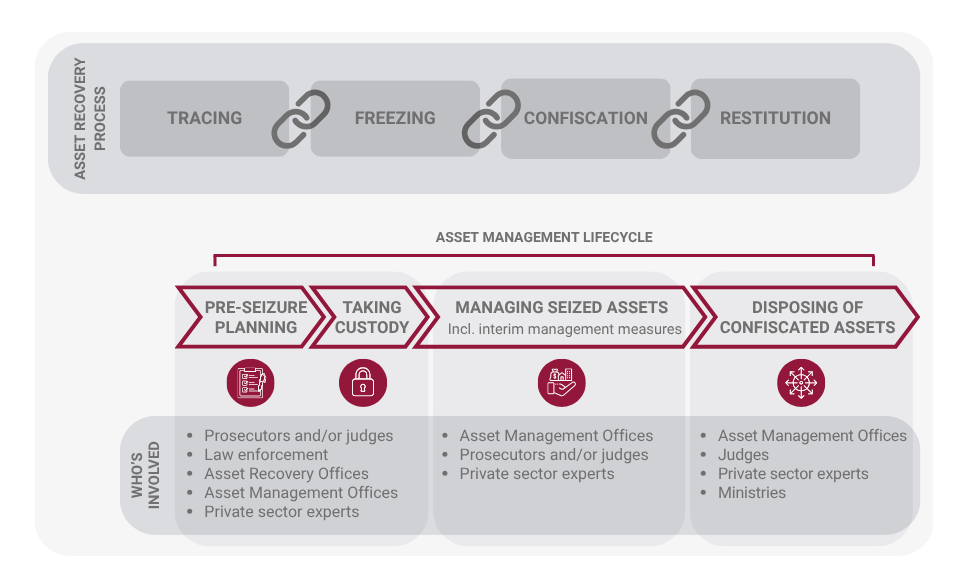
Here are some key considerations for each phase of the asset management lifecycle:
1 Pre-seizure planning
This is the critical stage when criminal assets have been identified and are targeted for seizure. It involves anticipating and preparing for challenges, including legal compliance issues. Authorities should ask:
- Will any of the assets be used as evidence, and how will the chain of custody be preserved?
- Are there measures that can place the asset under the court’s authority without taking physical control?
- Who are the legal and beneficial owners? Are there third-party interests? Known or potential liabilities such as mortgages or leases?
- Which agency or individual will be responsible for managing the asset?
- What are the asset’s transportation, storage, security and maintenance needs – and what will they cost?
- What is the asset’s current market value, and how quickly is it likely to depreciate?
- Is an interim sale or disposal option legally available – particularly for perishable or high-risk assets such as livestock or vehicles?
- In cross-border cases, which country will bear the cost of asset management?
2 Taking custody
Authorities take custody by taking possession of, or control over, the assets. Measures should be tailored to the nature of the asset:
- Physical seizure is often used for movable items such as vehicles or jewellery.
- Legal restraint measures can restrict the transfer or use of immovable or intangible assets such as property or shares.
- Complex assets, such as businesses, may require the appointment of administrators.
- Cryptoassets need specialised measures, such as moving funds to a secure state-controlled digital wallet.
Custody also involves practical steps: secure transport, valuation and clear documentation. These ensure proper records are kept and support later decisions about asset management and disposal.
3 Managing seized assets
The management process must ensure legal compliance, minimise financial risks and remain transparent – whether or not the assets are ultimately confiscated.
Assets should be regularly monitored and valued to inform decisions on storage, care or sale. This is especially important for assets with unstable value. Many countries permit interim management measures to reduce costs and prevent asset deterioration:
- Interim use – for example, law enforcement using seized vehicles.
- Interim sale – for perishable or costly assets such as boats or Proceeds must be held until a final decision and returned if the owner is acquitted or there is no confiscation order.
- Destruction – used for hazardous, illegal or unsellable assets such as drugs, weapons or obsolete electronics.
4 Disposing of confiscated assets
This is the final step in the asset management lifecycle, carried out after a confiscation order. The goal is to recover the proceeds of crime and allocate them in a way that benefits society.
Assets may be sold, reused or destroyed, depending on their type and condition. Common disposal methods include:
- Official use – for example, converting real estate into government offices or training facilities.
- Social reuse – repurposing assets for community centres, housing or other services.
- Destruction – for unsafe or unsellable items such as weapons, drugs or contaminated goods.
- Sale – through public auctions, tenders or private sales. Proceeds typically go to the national treasury or special funds for victim compensation or other purposes.
Putting asset management into practice
Effective asset management is essential for successful asset recovery. Poor handling of seized property can lead to loss of value, legal challenges and lost opportunities to return funds to the public. To avoid these risks and maximise impact, countries should take practical steps to strengthen their systems.
Key actions include:
- Develop or update legal frameworks to provide a clear mandate for asset management.
- Establish or reinforce Asset Management Offices with sufficient expertise, authority and resources.
- Invest in technology to support asset tracking, case management and secure custody, including for digital and intangible assets.
- Use clear procedures and safeguards for high-risk activities such as procurement, storage, interim sale and auctions.
- Explore opportunities for public–private partnerships, especially in areas such as valuation, maintenance and logistics.
- Encourage cross-agency coordination between Asset Management Offices, law enforcement, prosecutors and courts to ensure a cohesive approach from seizure to disposal.
- Define strategic policies on asset disposal and allocation, prioritising transparency, fairness and public benefit.
- Provide regular training and guidance to those involved in asset management, especially where roles or rules are newly defined.
While approaches will vary depending on the national context, all systems benefit from clear rules, strong institutions and a focus on preserving value.
Further reading
- G8 Lyon/Roma Group Criminal Legal Affairs Subgroup. 2005. G8 Best Practices for the Administration of Seized Assets.
- Basel Institute on Governance. 2012. The Need for New EU Legislation Allowing the Assets Confiscated from Criminal Organisations to be Used for Civil Society and in Particular for Social Purposes.
- 2017. Study prepared by the Secretariat on the effective management and disposal of seized and confiscated assets. CAC/COSP/WG.2/2017/CRP.1.
- 2019. Revised draft non-binding guidelines on the management of frozen, seized and confiscated Assets. CAC/COSP/WG.2/2019/3.
- Walugembe, Tom. 2020. The Serwamba case: achieving Uganda’s first successful money laundering convictions. Case Study 1. Basel Institute on Governance.
- Spicer, Jonathan. 2021. Managing seized and frozen assets – what are international norms? Basel Institute on Governance.
- Stolen Asset Recovery Initiative (StAR). 2023. Managing Seized and Confiscated Assets: A Guide for Practitioners. Washington, DC: Stolen Asset Recovery Initiative (StAR).
- Council of Europe. 2023. Guidelines for the management of seized assets. Strasbourg: Council of Europe.
- Council of Europe. Conference of the Parties. 2024. Thematic Monitoring Review of the Conference of the Parties to CETS No. 198 on Article 6 (“Management of Frozen or Seized Property”).
- Dornbierer, Andrew. 2024. The disposal and sharing of confiscated assets – best practices. Quick Guide 31. Basel Institute on Governance.
- Financial Action Task Force (FATF). International Standards on Combating Money Laundering and the Financing of Terrorism & Proliferation: The FATF Recommendations. Updated June 2025.