Research Case Study 3
Research Case Study 3
A pilot behavioural anti-corruption intervention at a public hospital in Dar es Salaam, Tanzania successfully reduced unofficial “gift-giving” to health workers by targeting underlying social norms and leveraging peer influence. The initiative trained staff champions to promote anti-corruption messages within their networks and used environmental cues such as posters and desk signs to reinforce the message that gift-giving is unethical and unacceptable. Surveys showed a 14–44% reduction in patients’ intentions and attitudes toward gift-giving, though beliefs around gifts given as gratitude were harder to shift. The intervention highlights the potential of social norms and behaviour change strategies in tackling corruption in public services.
Lista de secções
-
May 2023
Exposing the networks behind transnational corruption and money laundering schemes
We applied analytical tools to reveal the complex networks behind a corruption and money laundering scheme involving Odebrecht and Peru’s former president. The insights can support strategic approaches to fight transnational corruption.
What’s the problem?
Corruption is increasingly understood as a form of collective, social behaviour. It slips easily across borders and involves sophisticated financial strategies and transactions to launder the stolen money.
Yet the nexus between corruption and money laundering is poorly understood. So too are the structures, functions and mechanisms that enable these crimes.
Narrow approaches to studying corruption, which focus only on individuals and their self-interested behaviours in the national context, provide an incomplete picture.
Using social network analysis and network ethnography, we can shift the focus from individuals to networks and explore both who is involved and how these schemes work. The findings offer valuable insights to inform anti-corruption policies, law enforcement strategies and academia.
What we did
Where
Brazil and Peru, and offshore infrastructure in Costa Rica, Panama and the UK.
Who
A grand corruption scandal involving former Peruvian President Alejandro Toledo and his laundering of bribes from Brazilian construction giant Odebrecht.
Why
To better understand how the nexus between corruption and money laundering works and, specifically, the role of hidden and offshore financial infrastructures in this process.
How
By applying social network analysis and network ethnog- raphy techniques to publicly available data from the Lava Jato and Ecoteva investigations in Brazil and Peru, including judicial documents, newspaper articles and public reports by authorities, parliamentary commissions and civil society organisations.
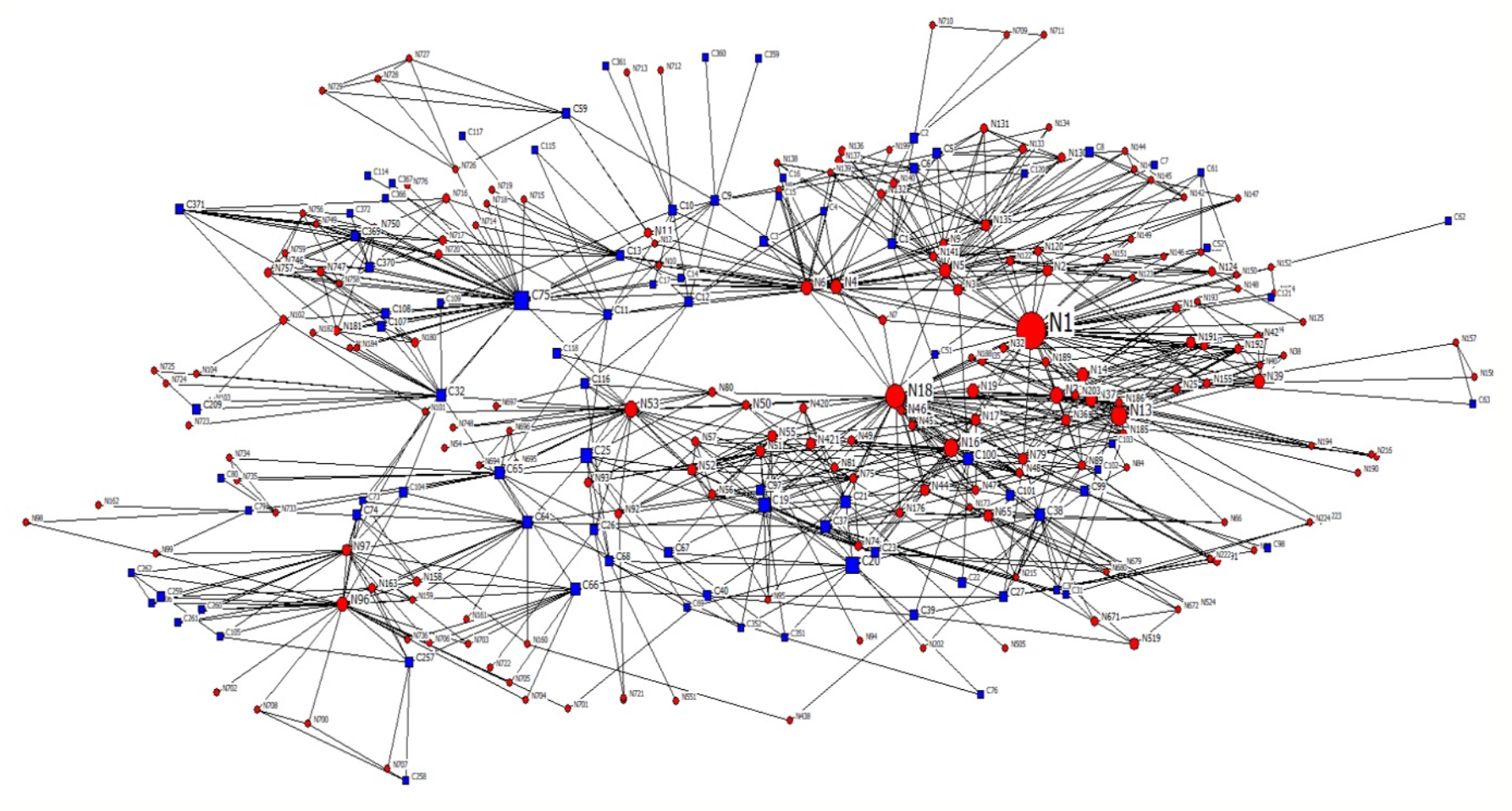
A visualisation of the complex network that enabled the corrupt deal between Toledo and Odebrecht. The network consists of 281 nodes — 193 individuals and 88 collective entitles (e.g. businesses, associations, public institutions). What we found
- Money laundering schemes are strategically and systematically used to facilitate and conceal corrupt exchanges and gains.
- The corruption and money laundering schemes are highly technologically and financially sophis- ticated. Complex illicit exchanges take place across borders and within the murky space of offshore financial infrastructures.
- A web of service providers, companies, offshore corporate vehicles and bank accounts efficiently facilitate the interactions between political and business actors.
- Social norms and informal governance practices regulate the transnational network.
- Strategic decision-making is centralised among the core political and business actors. Operations are decentralised.
- The networks are highly efficient, effective and resilient. This makes dismantling them challenging.
Why it matters
- Corruption networks evolve and innovate their strategies. Those seeking to combat corruption need to stay abreast.
- Looking at corruption beyond the confines of individuals and national borders is critical. So too is international cooperation to combat it.
- By incorporating innovative research approaches to uncover and understand the inner workings of corruption and money laundering schemes, we can strengthen the fight against transnational corruption.
- Fresh insights can bolster:
- global anti-corruption policies – like how to reduce the abuse of offshore financial centres;
- law enforcement strategies – like which criminals and clusters to target and which strategies to employ;
- academic theories – like empirical evidence on the relation between grand corruption and money laundering.
About this case study
This is part of the Basel Institute on Governance Research Case Study series, licensed under CC BY-NC-ND 4.0.
Author: Jacopo Costa (2023). Available at: baselgovernance.org/publications/research-case-3
Keywords
Social network analysis, Network ethnography, Informal governance, Corruption research, Money laundering, Offshore structures, Secrecy jurisdictions
Further Reading